Distinguishing True and False Box Men
The Box ManDistinguishing True and False Box Men is presented as a question of lived experience rather than outward appearance: a box man’s authenticity is supposed to be proved by ordeals and knowledge that an imitator cannot reproduce. But the narrator’s own reversals—claiming to be the genuine article, later confessing to being fake, and invoking the dead man’s notes as authentic—make the distinction unstable. It becomes both a practical test of life inside the box and a problem of who has the authority to tell that life.
A Test of Experience, Not Appearance
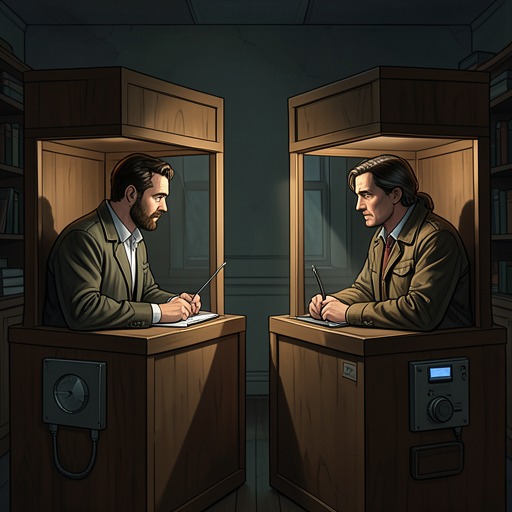
The narrator proposes reversing the usual question. Rather than trying to identify the real box man directly, he suggests asking who is not one, because the real box man has experiences and adventures that only someone who has lived in the box can describe. Authenticity is thus grounded in accumulated, particular knowledge, not simply in wearing a box or adopting the name. The claim sounds decisive, but it also makes the test difficult to verify: the reader encounters the supposed proof through the narrator’s account, while the narrator himself will undermine his authority to speak for the real thing.
The account of a first summer in the box supplies the most physical version of this test. The heat brings suffocation and an urge to scratch away one’s memories, but the narrator distinguishes heat—which can sometimes be endured by standing near the air-conditioning outlet of a building entrance facing an underground passage—from sweat that stays wet, gathers dirt, and prevents the skin from breathing. The accumulated grime becomes a culture for bacteria, yeast, and mold; the itching of disintegrating skin is described as harder to bear than visceral pain. These details make the box man’s credentials bodily: they consist not in a dramatic declaration but in enduring the slow, intimate discomfort of a body trapped under the box.
The narrator says that after four or five days the discomfort almost disappeared. He cannot determine whether his skin had grown used to the dirt or his body had adapted its oxygen consumption, and he reports that he came to sweat very little. The uncertainty matters: the ordeal changes into a condition that can be lived with, even as its bodily evidence becomes less visible. In the narrator’s formulation, sweating marks the fake box man. The criterion is therefore not simply suffering, but adaptation to the box’s particular conditions—a claim that makes authenticity depend on a bodily process that outsiders may neither witness nor readily judge.
Skills and Knowledge of Box Life
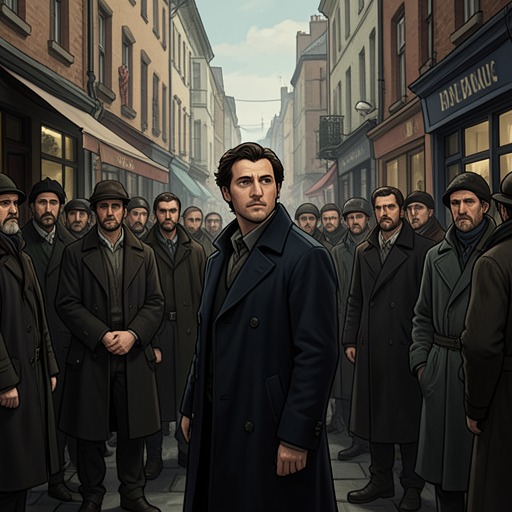
Authenticity is also tested through practical competence. The narrator describes Wappen beggars as a particular danger to a box man: one repeatedly shrieks at him, then catches him off guard and thrusts a small rising-sun flag through the top of the box. The narrator realizes that the flag’s haft might have pierced his ear. After this attack, he decides to strike first against Wappen beggars and learns to throw heavy objects from inside the box. He explains the technique in physical terms: the right arm bends horizontally, passes through the observation window, and uses the elbow as a fulcrum while the upper body and box twist left; the arm then extends toward its target, like a discus throw without a run-up. In this account, knowing how to inhabit a box includes learning how to defend oneself from a threat that is specific to that existence.
The same emphasis on knowledge appears in the discussion of food. The narrator describes looking for dried, odorless provisions among restaurant discards, where plentiful leftovers are often collected in plastic containers for hog-farm trucks, while foods with a definite shape—such as bread, fried items, dried fish, cheese, pastry, and fruit—are harder to find. Yet he says a box man can obtain food from store counters and need not depend on scavenging leftovers. Foraging remains useful because it teaches him the town, a necessary part of enjoying life among its crowds. The difference between mere imitation and lived identity is again expressed as acquired familiarity: the box man has learned how the city works from his position inside the box.
The Box Man’s Time and the Question of Universality
Once the box man has become accustomed to the town, time takes on a distinctive shape around him. The background moves quickly, the foreground passes at a snail’s pace, and the center remains perfectly still. The narrator connects this temporal arrangement to boredom: the real box man is never bored, whereas boredom belongs to the fake box man in his box. The distinction reaches beyond costume or technique. It proposes that authentic box life changes how the world is experienced—what moves, what lingers, and what counts as the center of attention.
The narrator then widens the question, asking which of them was not a box man and who failed to become one. This rhetorical turn unsettles the earlier division. If the experience can be posed as a possibility that concerns everyone, the box man is no longer only a figure whose authenticity can be settled by inspecting an individual’s credentials. The account keeps both propositions in play: box life has ordeals and skills that are exclusive to it, yet the question of who has been or could become a box man is left open rather than resolved.
Competing Claims and Uncertain Testimony
A hospital encounter makes the problem of recognition explicit. The narrator reaches a locked hospital on a day when a card announces there are no examinations. When the girl opens the door, she apparently mistakes him for the fake box man or the fake doctor and ushers him inside while grumbling. He tries to correct her and identifies himself as the real thing, adding that he is the former photographer who waited under the bridge the previous night. Her surprised scrutiny does not settle the matter; she says he has failed to keep his promise and tells him to take off his box. The scene shows how outward presentation and another person’s expectations can misidentify the person inside the box, while the narrator’s insistence on being genuine remains a claim rather than proof.
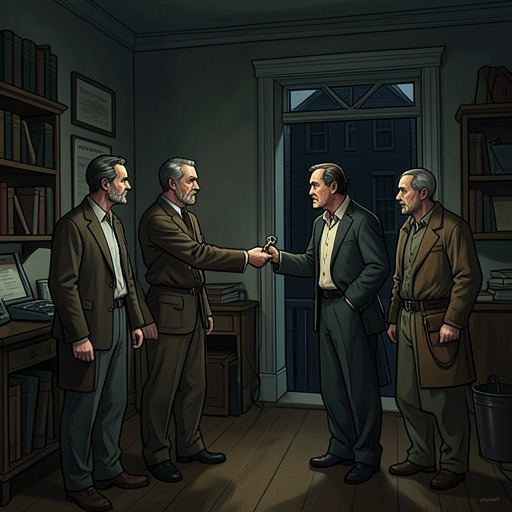
Later, the narrator confesses that he was a fake. He then distinguishes himself from the notes he has brought forward, calling them the real thing and describing them as the will the real box man entrusted to him. This separates the speaker’s status from the supposed authenticity of his document: a false box man may still transmit a true box man’s writing. But the text immediately warns against accepting that claim without reserve. Writings left by the dead need not tell the truth; the dying may have jealousies and envies unknown to survivors, and hatred of easy promises of truth can lead some to nail the coffin lid shut with lies. The notes’ attribution to the dead man is therefore not enough to make them reliable.
The concept remains deliberately unsettled. Bodily endurance, defensive skill, knowledge of the town, and a changed sense of time all offer concrete grounds for distinguishing experience from imitation. Yet the narrator’s shifting self-description and the suspicion surrounding the dead man’s notes prevent those grounds from becoming a final verdict. The distinction between true and false box men is at once necessary to the account and vulnerable to the same problem it seeks to solve: every claim to authenticity arrives through a speaker whose own status may be uncertain.